The 3 Blades
A tale of an Axe, a Spear, and a Saber
Preface:
As this isn’t a recipe blog, I won’t hold you hostage with my life story and the origins of my bloodline, but I do need to provide a small amount of background context just so this all makes sense. First, this is not meant to be an universal organization system to catalogue every kick from every discipline, thus superceding the teachings of masters, senseis, and coaches over the last few millennia. Second, this system is fluid, and doesn’t categorize 100% of all kicks ever, but I’d say it applies to probably like 90% of them. Finally, it’s all for fun! If this helps your understanding and learning capability for kicks, sick! If not, disregard it! There are many ways up the mountain, not just the path of the GOAT. Kidding, double pun.
The 3 Blades
The axe, the spear, and the saber: each are anachronistic weapons of war, which are all essentially just sharp sticks, but that’s where their similarities end! Each have their own specific uses, advantages, and weaknesses, and each need to be wielded in a specific fashion. First, let’s begin with the simplest blade: the axe.
Axes
Axes are used for chopping (groundbreaking, I know) and thus, to be used most effectively, they must be swung with great velocity with their blades at a perpendicular angle at the termination of their arc. Here’s some physics for you, if you’re into that:
How does this translate into kicks? Let us begin with the humble Roundhouse, specifically the Muay Thai style variation. Many times, when learning Muay Thai, they’ll start you off with the low round kick designed for continually attacking the legs of your opponents, or “chopping down the tree” if you will. This metaphor kind of wrote itself during some of my training in Thailand, especially since I was usually the “tree” getting chopped down by much shorter opponents. They tend to hit with the lower half of the front of the shin, which kind of feels like the blade of an axe when you get hit by it 20 times in one round, and they want all of their velocity to come to a sudden stop when they make contact. This means they are effectively transferring all or most of their force into what or whomever they’re kicking with little to no follow-through. In fact, many times they use the rebound as a way to get their legs back into their original positions.
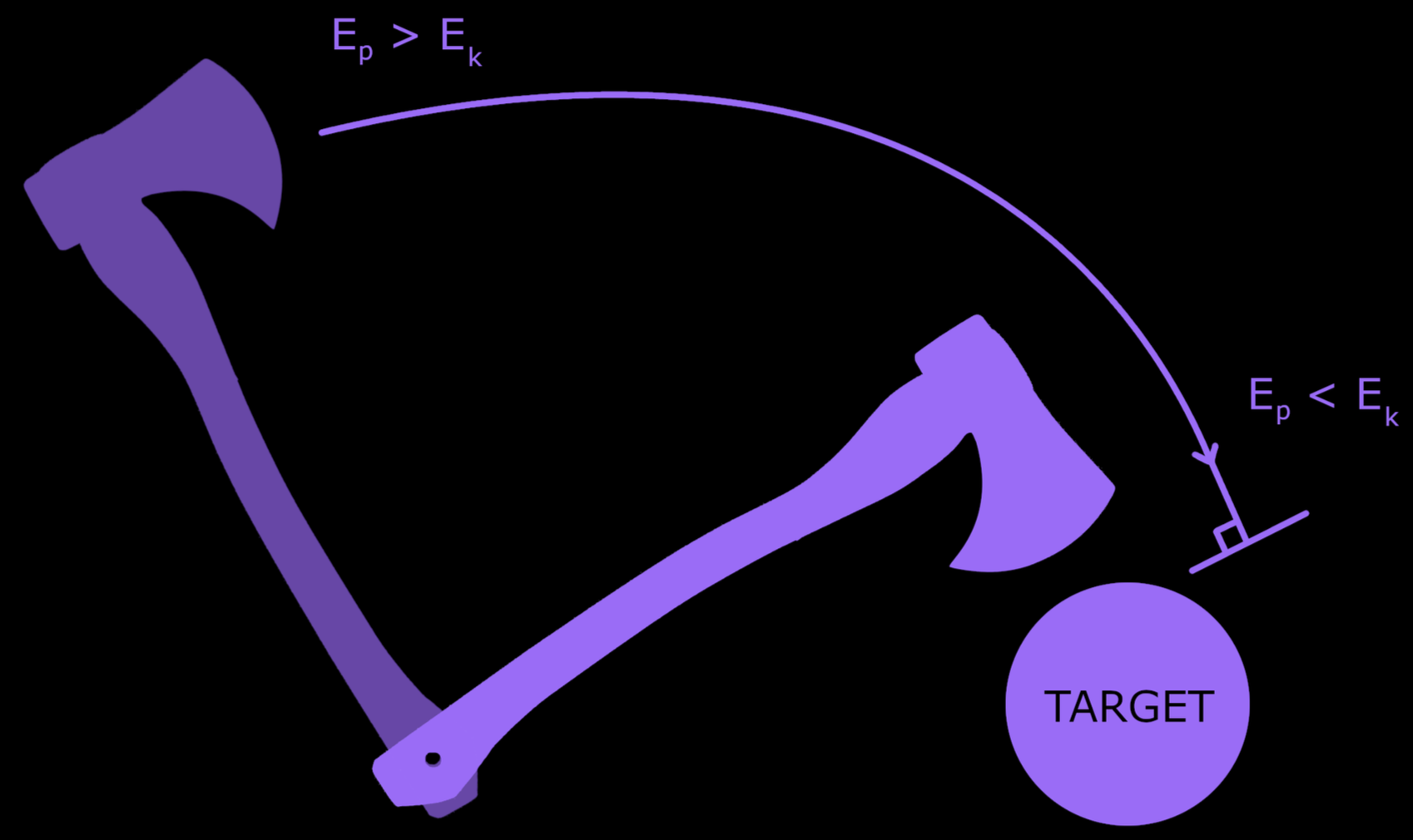
A physics diagram that I decided was absolutely needed
We can see that at the top of the swing, rotational tension is stored up, resulting in high potential & lwo kinetic energy, but as the target is struck, it is mainly kinetic energy dispersing.
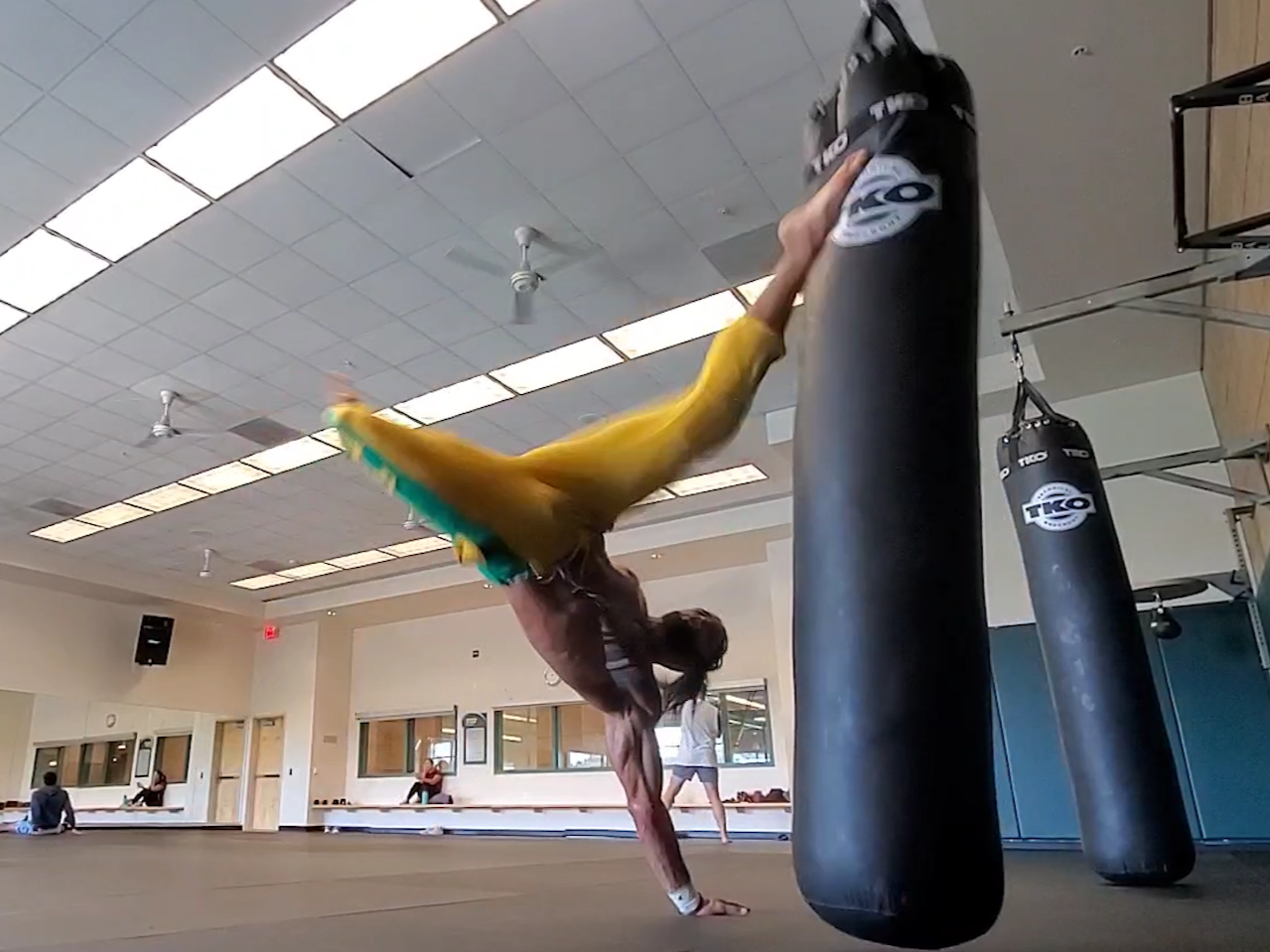
This kick actually depends the rebound so I can land on my feet
For me, these are the strongest of the radial kicks and I usually either push back or double up my kicks on the same side. When hitting a bag, you can see that I typically bounce back off or post my kicks at their fullest extension. Here’s some examples of axe-like rounds on the bag:
spears
Spears are also pretty straight-forward, they are for stabbing although I think it’s more helpful to see it as a thrusting motion as there is typically a significant follow through. There’s usually no radial motion involved in a thrusting motion, just good ol straight line Newtonian physics, so no diagram for this one. Again, all or at least most of the force generated at the beginning of a spear-like kick should be transferred into the target at [ideally] another perpendicular angle.
For spears, let’s take the many Side Kick variations from Taekwondo as our examples. In position 1 (the “chamber” - leg fully adducted, tension stored, tibia pointed at target), potential energy is stored in the hip flexors, hamstrings, and tibia along the intended path of the kick. Then, in position 2 (the extension - leg is rapidly extended via coordinated flexion of the glutes, quads, and calves) the tibia should be catapulted forward, not losing alignment perpendicular to target, ideally the leg is very close to being straight without being locked.
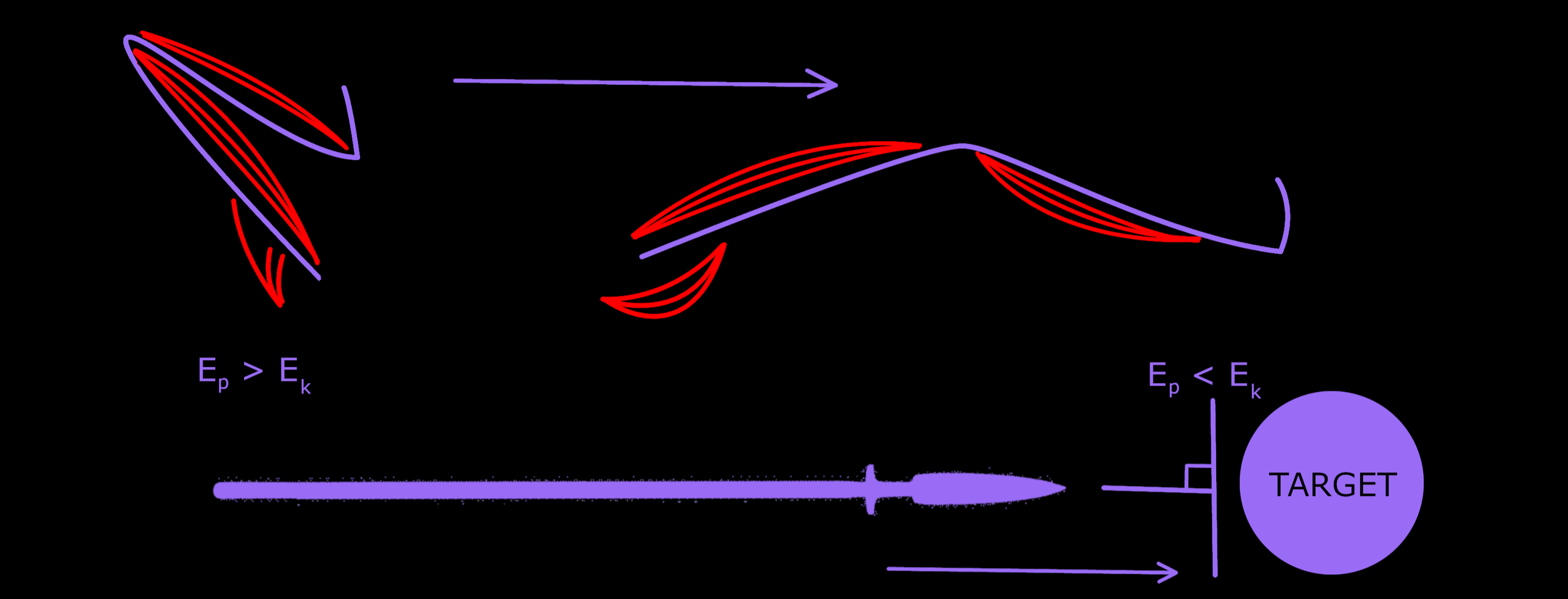
A comparison is often made to a Bow and Arrow, but I think it is more akin to an Atlatl (you should look that up, it’s sick)
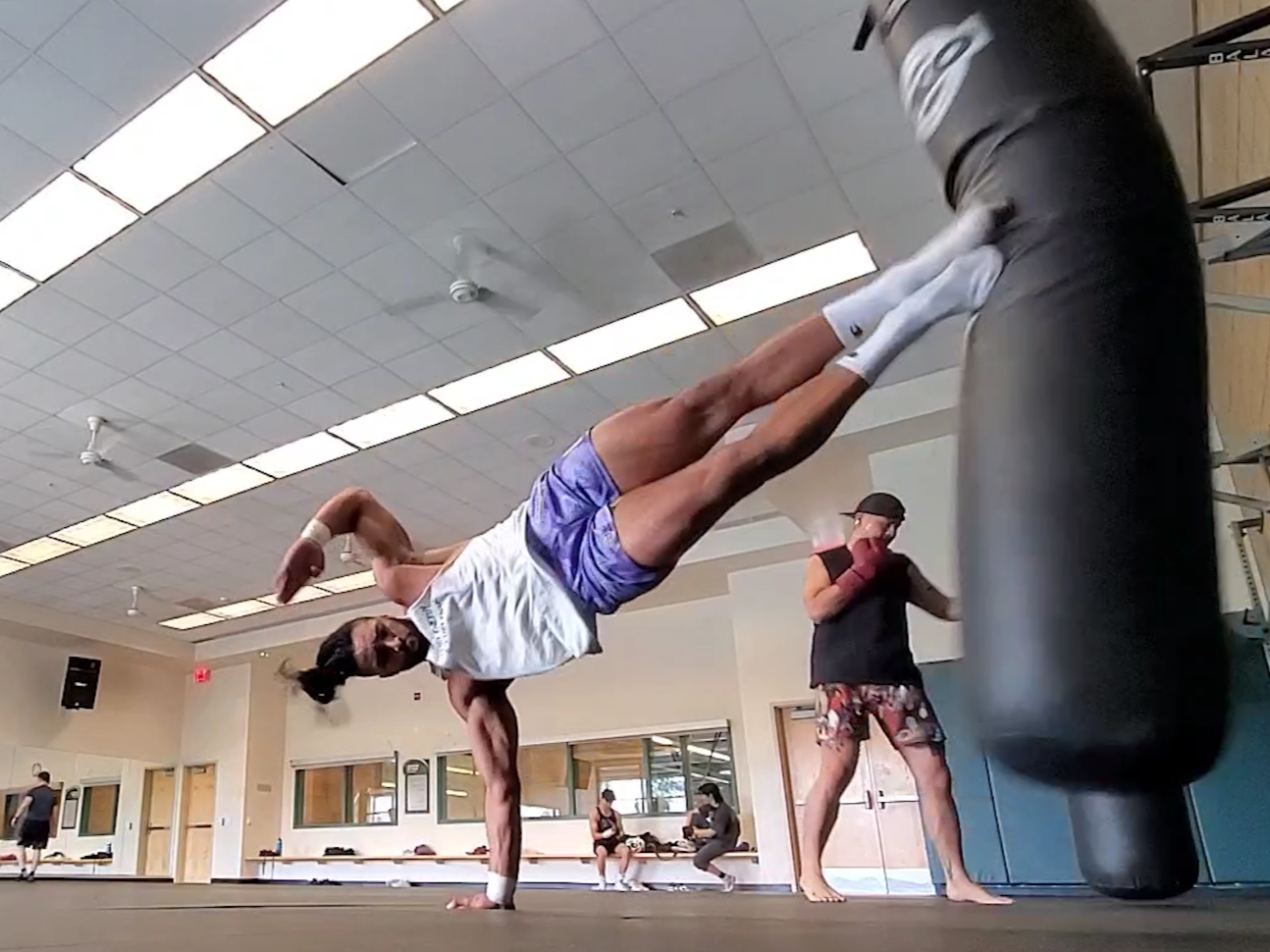
The ol flag drop kick, devestating and hilarious
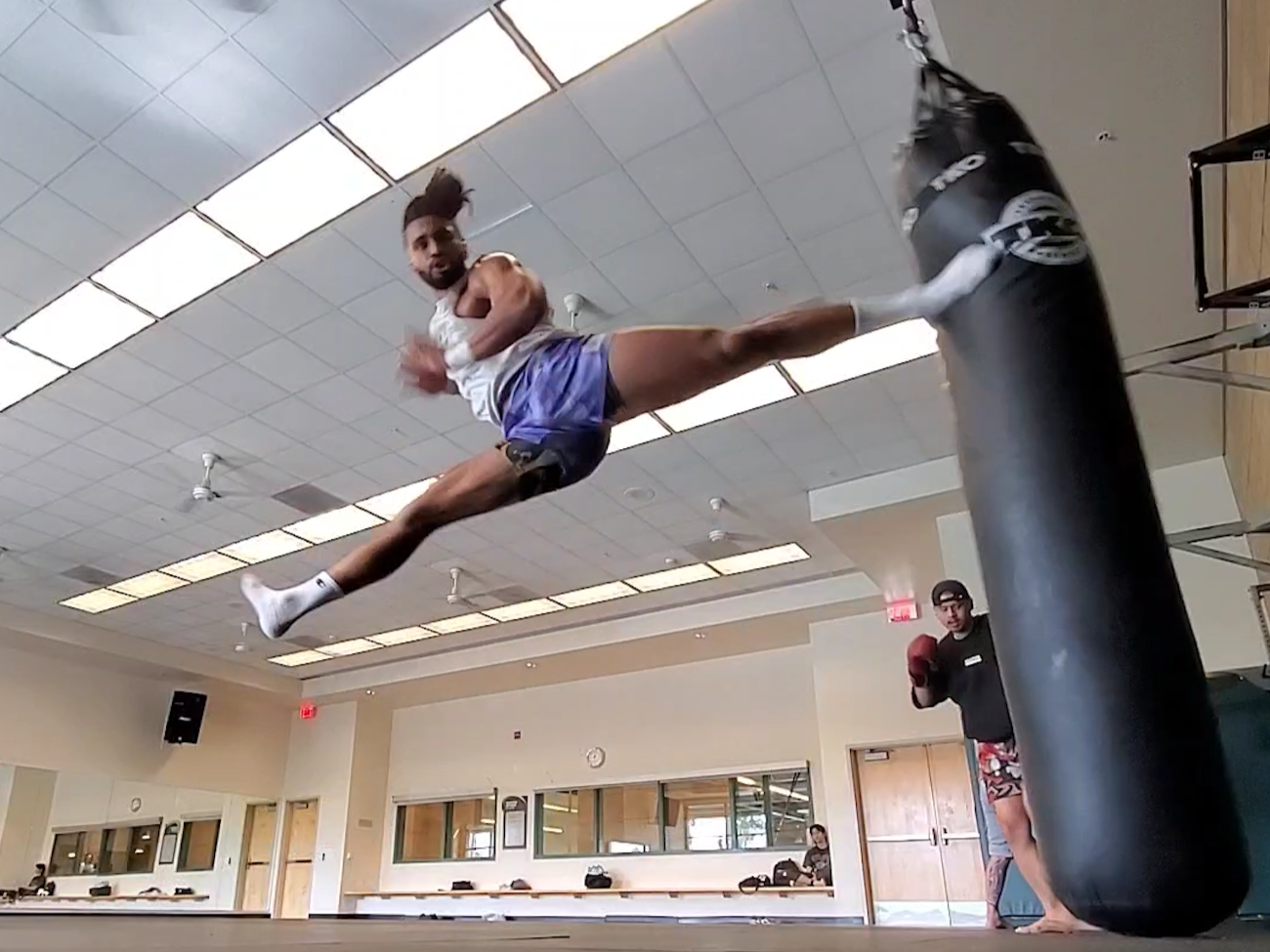
Split back kick, she’s iconic
A literal spear probably takes less technique to wield than an axe, but for this metaphor, it is typically more difficult to land an effective spear-type kick than an axe-type. There are also more axe-type than spear-type kicks, and just by nature they also have an easier target profile. This is due to having to more accurately judge distance and effective target surface area, which gives you more of a round shaped target while axes get more of a tall oval standing sideways. Let me know if that was confusing as hell.
Sabers
Sabers, or sabres for my British "friends", are essentially very sharp wheels if used effectively. Out of the 3 blades, these require the most skill to be truly well-utilized, this is because in addition to a strong grasp of distance, some sense of timing is also needed. Spear-types also have a high degree of variation, but many of them come with one or more of the following side-effects: blindspot, level change, re-chamber, or complex activation. These kicks are categorized as having a radial pathway, a whipping or snapping motion, and a very narrow target surface area. They also can have some intention of follow through as opposed to rebound, where all initial force is dispersed into the target and the leg is sent back along its initial path. This part actually makes more sense in the metaphor: the axe sticks into a tree and then is brought back along the same path, but a scimitar should glide through a - let’s say “vine” - leaving an uninterrupted semi-circular pathway.
When I throw a compasso, I usually aim to draw a big circle through my target, making contact only briefly with the ball of my foot. The traditional Capoeira method involves flexing the foot so that the heel makes contact with an opponent’s face, it passes right through and all the way back to its start position. Brutal. It’s entirely possible to wedge an actual saber into a target, but it’s not the best way to use it and you could even damage the blade that way.
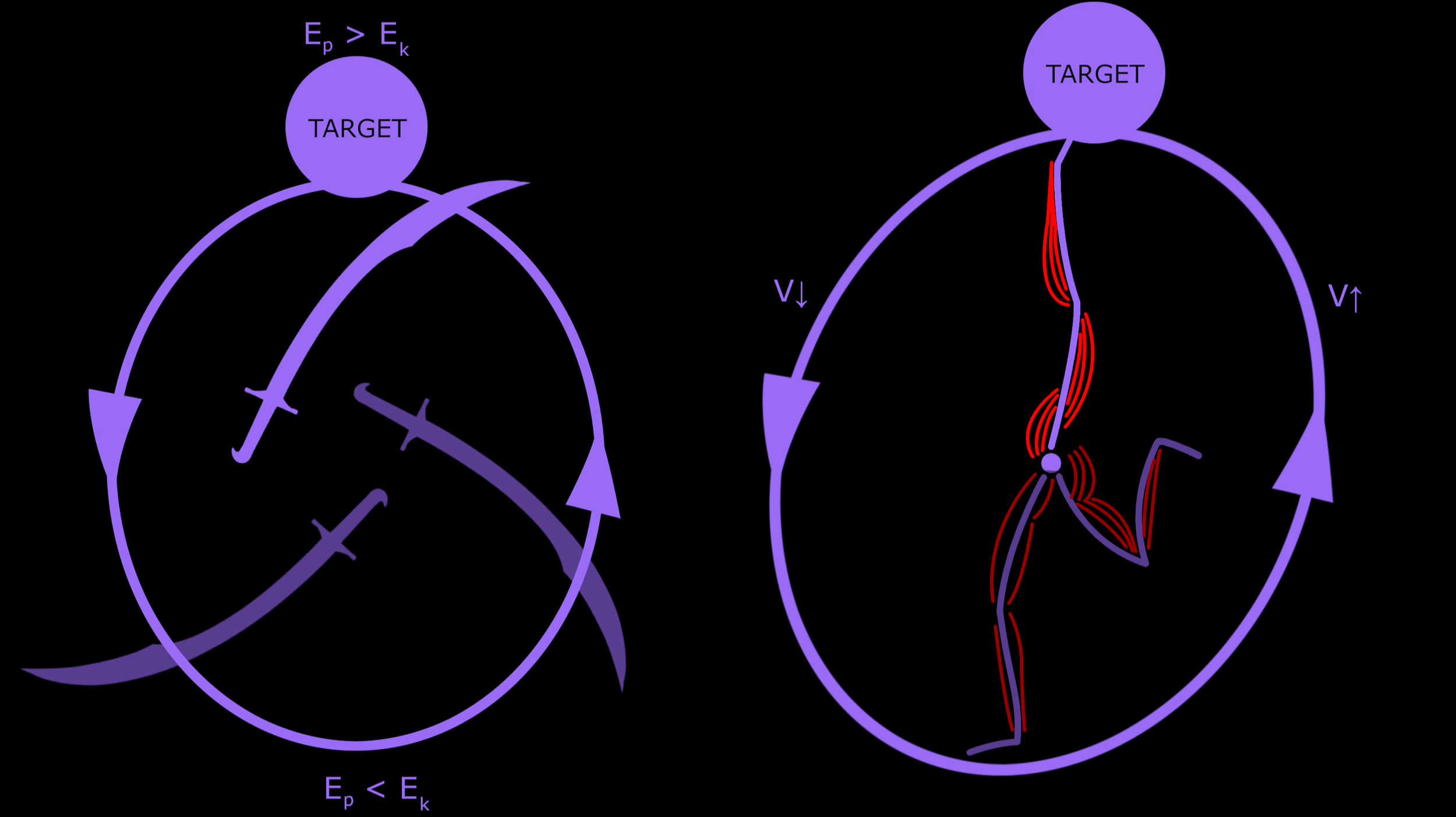
With the scimitar, one would swing the saber at an angle, maximizing the amount of contact between the target and blade as it runs through through its eliptical pathway. This also becomes true with whatever you decide the tip of your kick is, in my case it’s the ball of my foot. From the top-down view in the leg diagram on the right, you can see that tension is held pretty evenly, then compressed (glutes, hams, tibs), then whipped out and extended by flexing the glutes, quads, and calves.
Here we have a combo of 2 compassos (saber), an au amazona (axe), and a split back kick (spear) in series, putting that WORK on that bag.
Like the literal blade, saber-type kicks also have a higher skill floor and the best understanding of space x time out of the three. However, as stated, they do have a lot of variation within their movelist, so they can kind of be what you want them to. And like I said, this system isn’t the end-all be-all.
Conclusion
I always just want to wrap it all up with a good strong “and uh, yeah”, but I’m going to make some effort this time. This system was created by one guy who isn’t even a real martial artist, according to the real internet martial artists, so I will claim no authority on the inner workings of the fighting arts. Classifying kicks by these here three blades has just been an easy way for me to understand and optimize the mechanics involved in each.
Each of the blades behave differently and have their own specific uses, but of course, mixing and mashing are a great way to trick opponents, create new shapes, and look dope on camera. Whatever you use your kicks for, ideally this system helps you to classify them better. Here’s another way to think about it: in Elden Ring terms, I’d say Axes are for strength mains, Spears are more of a strength-dexterity tool, and Sabers are straight up dex weapons. That analysis is really just based on how easy/difficult kicks in each category are to learn or pull-off effectively, once the techniques are well within understanding, they can kind of be whatever you need them to be.
As many of you know, I’ve never had any formakl training, so all of this is just my attempt at forging an understanding of a wide variety of martial artsPersonally, I like to have visuals that I can match up to my instrinsic understanding so that I can compare & contrast my way to ultimate victory. Some call that being a visual learner, others call it insane. Anyway, my only hope is that you take some value from what I’ve written here, and that this new knowledge/perspective can serve you in some way. At the very least, you can always use it to steer a conversation in a really weird direction. The hoes love that.
