Side-Quest: Learning Calculus
In addition to keeping my body in top condition working order for all the work and play I enjoy, I also try to hone my mind so I can always be learning. One of the best things you can do for your mind is to learn new things, and so for the last few years I’ve been doing “side-quests” where I practice something I’m not good at or just try and straight up tackle a new subject. I’ve gotten better at Freediving, reading/writing Chinese, charcoal grilling, dance choreo, and copywriting, and I’ve learned SQL/R coding, nunchucks, advanced sewing, car repair, and a bunch of other random skills. Are these all applicable? Probably not, but I know how to do something I couldn’t do before, so that’s a win for me. This last month, I chose to learn Calculus, and for probably the dumbest reason you’ve ever heard.
The Reason:
When I was on Paper Made, there was a scene where my character had to tutor another character in calc, which I did not know how to do. Actors will run into all kinds of situations where there might be a knowledge gap of some kind, and that’s where the acting is supposed to come in; use whatever similar skills or experiences to fill the gaps in a convincing manner. I understood that, and have even done that before while playing a scientist, but this was the first time I’ve ever seen something so foreign that I couldn’t even read the formula that was in the script, let alone contextualize it.
I ended up calling my best friend from high school who lives in France and is a doctoral candidate for physics and he broke it down enough for me to do the scene, but it never sat right with me. Most of my friends in high school and college had done calculus at some point, and here I was not even understanding what its use was all these years later. The combination of the constant proximity of the subject and my own unquenchable thirst for knowledge eventually led me to decide to learn this topic well enough to do at least a low level of calc, and here we are.
The Process:
The first thing I had to do was to understand where in the hierarchy of math calculus lie. I knew it typically gets taught after Trigonometry, which I’d taken, but I didn’t know what it was used for. Back to YouTube University for “What is Calculus used for?”, visualizations of basic functions, and a brief history of calculus so that I could at least conceptualize it. I think that math is always easier to understand once you know what it looks like and what it is meant to be used for, especially when equations have more letter variables than numbers.
Wanna know something crazy? Neptune was discovered [by the West] using calculus! Every other planet in our solar system was observed either with the naked eye or with a telescope, but Neptune? Neptune was mathematically predicted in 1846 by some French nerd named Urbain Le Verrier based on irregularities in the elliptical orbit of neighboring Uranus. Now that’s not the most complex math by today’s standards, but here’s two things I find crazy about it:
Pluto, which is less than a twentieth the size of Neptune, was discovered via telescope (albeit 84 years later).
Taking an integral of an ellipse isn’t rocket surgery, but if you’re working with sections of a planet’s orbit, a Neptune year is 164 Earth years, and an Uranus year is 84. That means that Le Verrier was working with an extremely small section of data to predict an even smaller section of data, which could then be scaled up to the full set (complete orbit). Keep in mind, Uranus was only discovered [by the West] 65 years prior to Neptune, meaning he used a piece of a dataset to predict an even smaller separate dataset. Shits wild bruh.
Next up was brushing up on Trig, which I surprisingly retained a good amount of, and then Pre-Calc principles. I thought this would take a week or so, but shockingly it all came back to me super quickly and I was good after just a couple of hours. The biggest thing was just remembering and writing down formulas and equivalents, such as tan = sin/cos or circumference = 2πr and so on.
Now, after an entire afternoon of prep, I began researching free online resources for learning Calc as well a trip to my local library! The library yielded more advanced resources, so I decided to come back after I could do the basics. I found a good amount of Calc review sites that I could use as a way to at least figure out where I should start, and I decided on limits & derivatives.
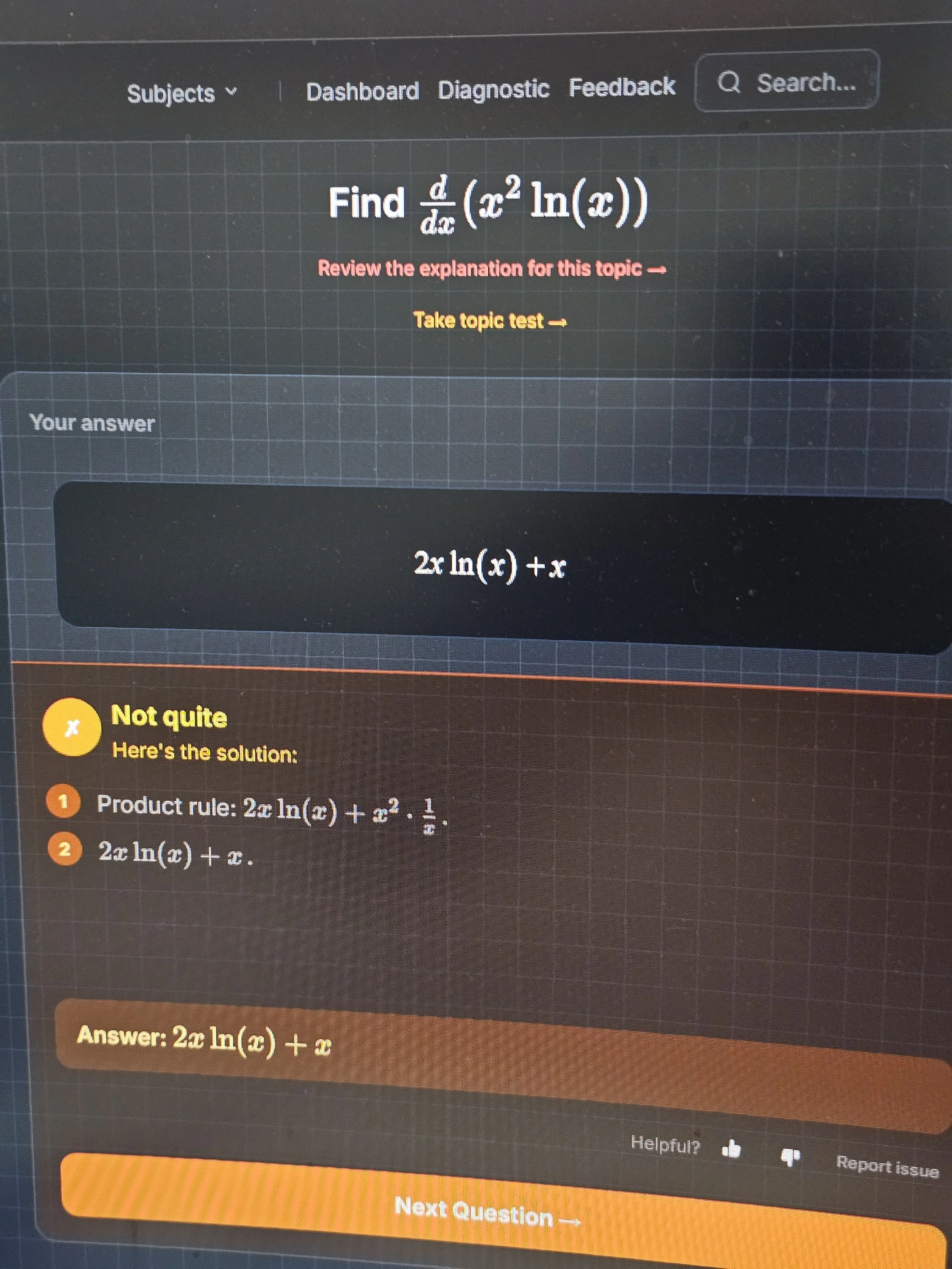
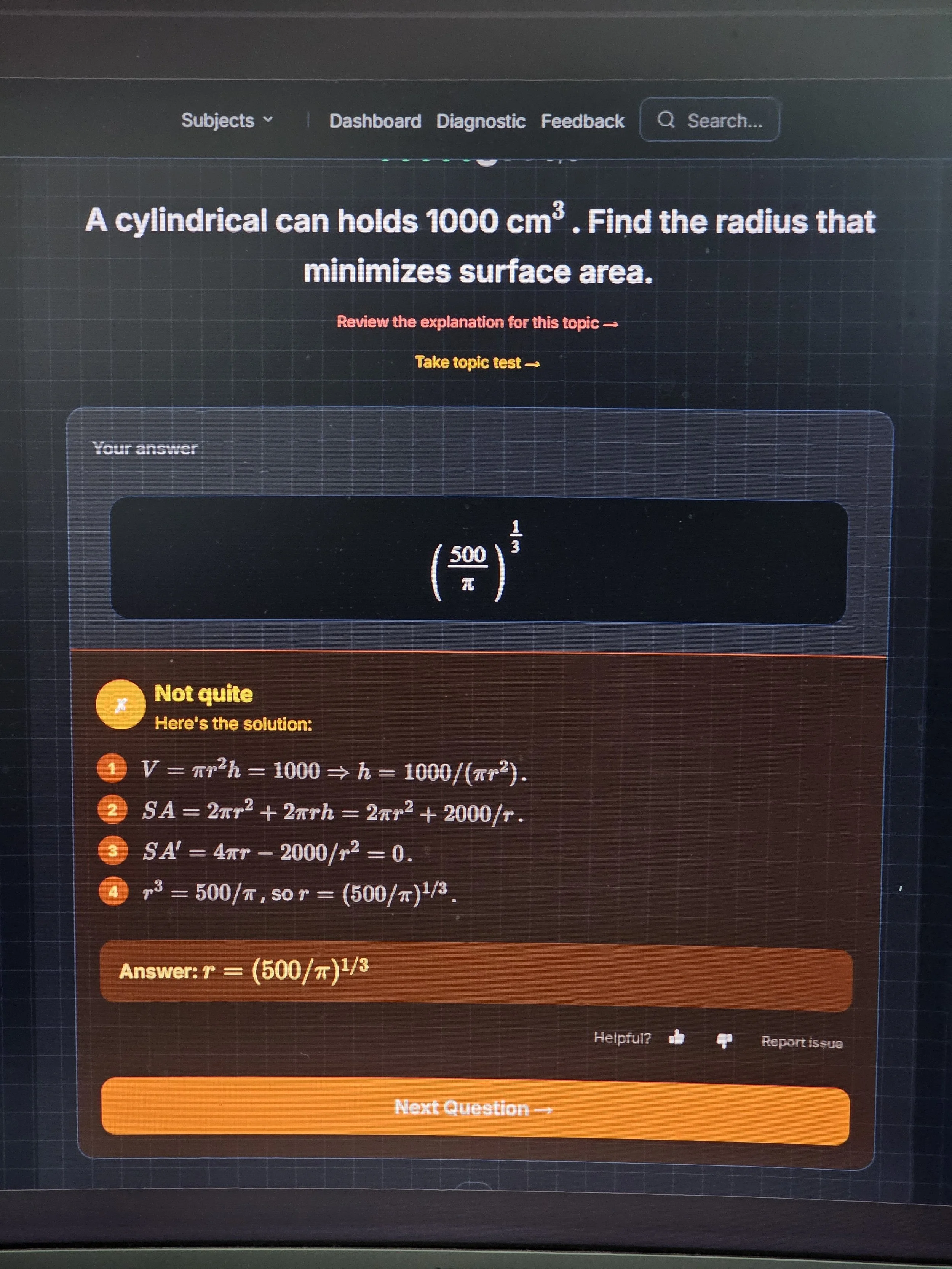
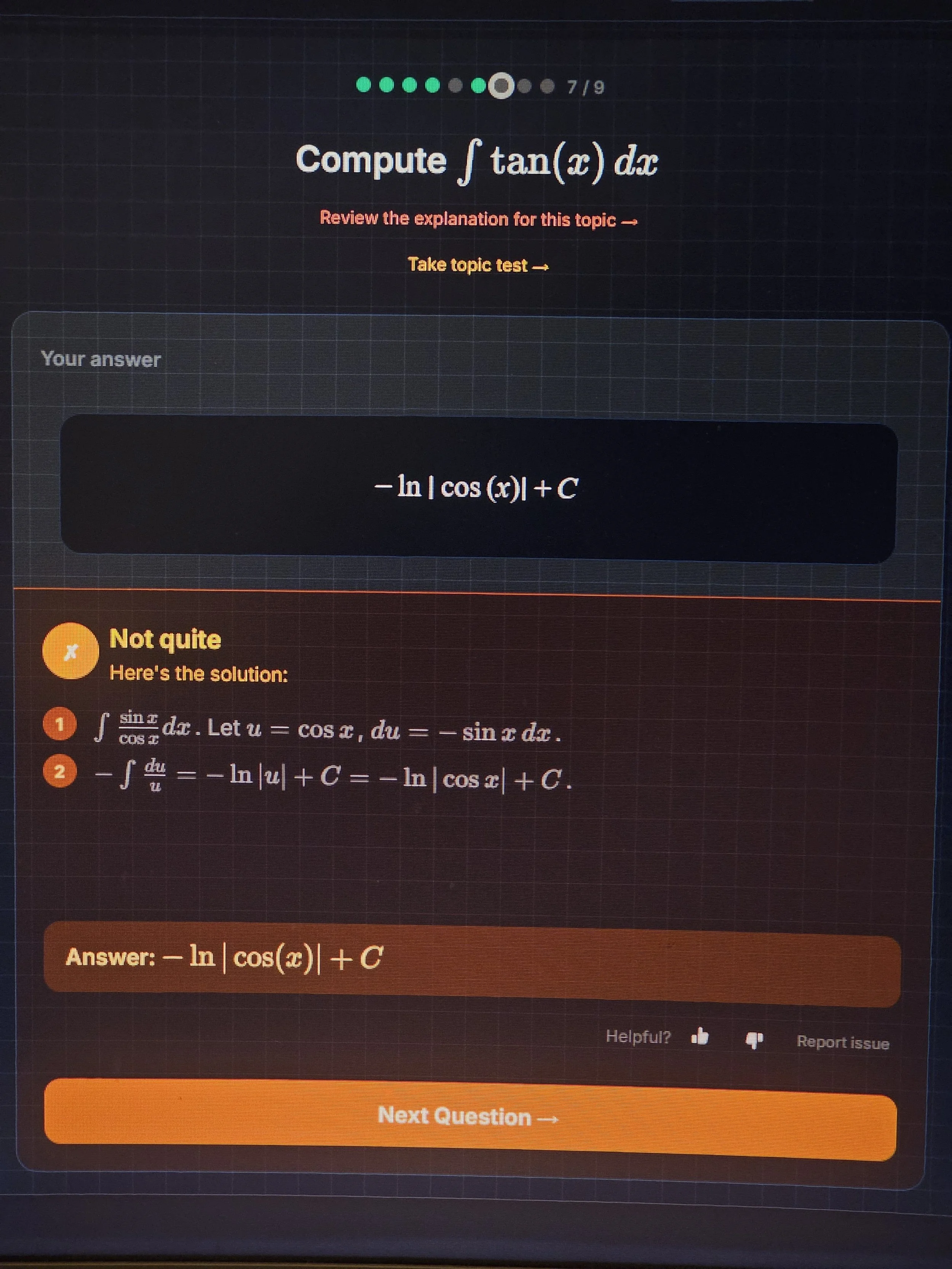
^I forgot how much online math test make me want to kill myself with their AWFUL INPUT UI.
Unfortunately, free resources leave a lot of blanks to be filled, but honestly I’m used to doing more with less, so after some practice, guessing, and a lot of visualization, I was ready for the next topic. There doesn’t seem to be much of a consensus on the order of learning topics for calculus, other than derivatives before integrals, so I decided to peek at an AP Calc AB AP test to see what topics were covered there. Now, I’m not so full of hubris that I believe myself capable of learning a year’s worth of advanced-level math in just 30 days, but I am arrogant enough to think I’d stand a chance at, say, the multiple choice section of said test. With that established, I was off to the races.
The Grind:
Derivatives took some time for me to nail down. It did become easier when I started being able to apply the math to basic physics, which some of you may know I use quite a bit for Tricking, but I was mainly held back by how ass I am at remembering Algebra II. Whatever, I can review as I learn, and that’s probably why I was so slow on the uptake. For example, though I’m familiar with it from high school math classes, I had no idea what the hell e was. Do you know what it is? I’ll tell you, it’s irrational, transcendental, the natural logarithmic base/exponential function, it’s also a constant approximately equal to 2.71828, oh and it's the integral of y=1/x that is equal to 1 where x>1. So simple once you get it, right? Anyway, that was just one of the many things I had to figure out while learning derivatives. There are also like a million rules to learn, which then all have to be reversed for Integrals later on, but we’ll fall at that hurdle when we get to it.
When I could muscle my way through some short answer problems, graph the limits, and predict continuity/discontinuity, I moved on.
Integrals were surprisingly a little easier, which I guess makes sense because they’re just derivatives reversed, but they still took me the better part of 2 weeks to get a solid grasp. If you’ve been lost reading this, I’ll briefly sum up what Integrals & Derivatives are for:
Derivatives are basically for finding smaller, higher level rates of change in a scenario. For example, if you have the distance traveled (position change) by a particle and the amount of time it’s traveled, you can take a derivative to find that particle’s velocity, and you can do it again to find its acceleration. An apostrophe (‘) is used to denote the derivative of a function f(x), so by taking continual derivatives of position over time s(t), we can find velocity s’(t), acceleration s’’(t), and jolt s’’’(t). So yeah, derivatives give you more specific rates.
Integrals do the exact opposite. Basically, if you have some specific information about, say, a planet’s orbit, such as its position relative to the sun, velocity (which always includes a vector), or even just its acceleration near its aphelion or perihelion, you can map out its entire orbit and calculate that ellipse’s area. Due to the nature of our very understanding, it’s easy to use general information to find [or “differentiate”] more specific information (i.e. taking acceleration from velocity data), but doing the opposite takes a little more doing. For one thing, differentiation (the process of taking derivatives) tends to shrink data. Taking acceleration from velocity results in losing some positional information, and to get that back during the integration process, we need to add back in a constant (C). It doesn’t really matter what the constant is (yet), it just needs to be there for when you finally put the big picture together fully.
The other little trick is to take “slices” of data piece by piece and then put them together until whatever you’re looking for starts becoming coherent, and the smaller the slices, the more accurate the final picture. It’s easiest to think of it like this: if you have a graph of velocity over time, and some crazy curve on that graph, the area beneath that curve will give you change in position aka distance [s’(t) → s(t)] and so on and so forth. Here’s a really good video that sums it up nicely: [video]
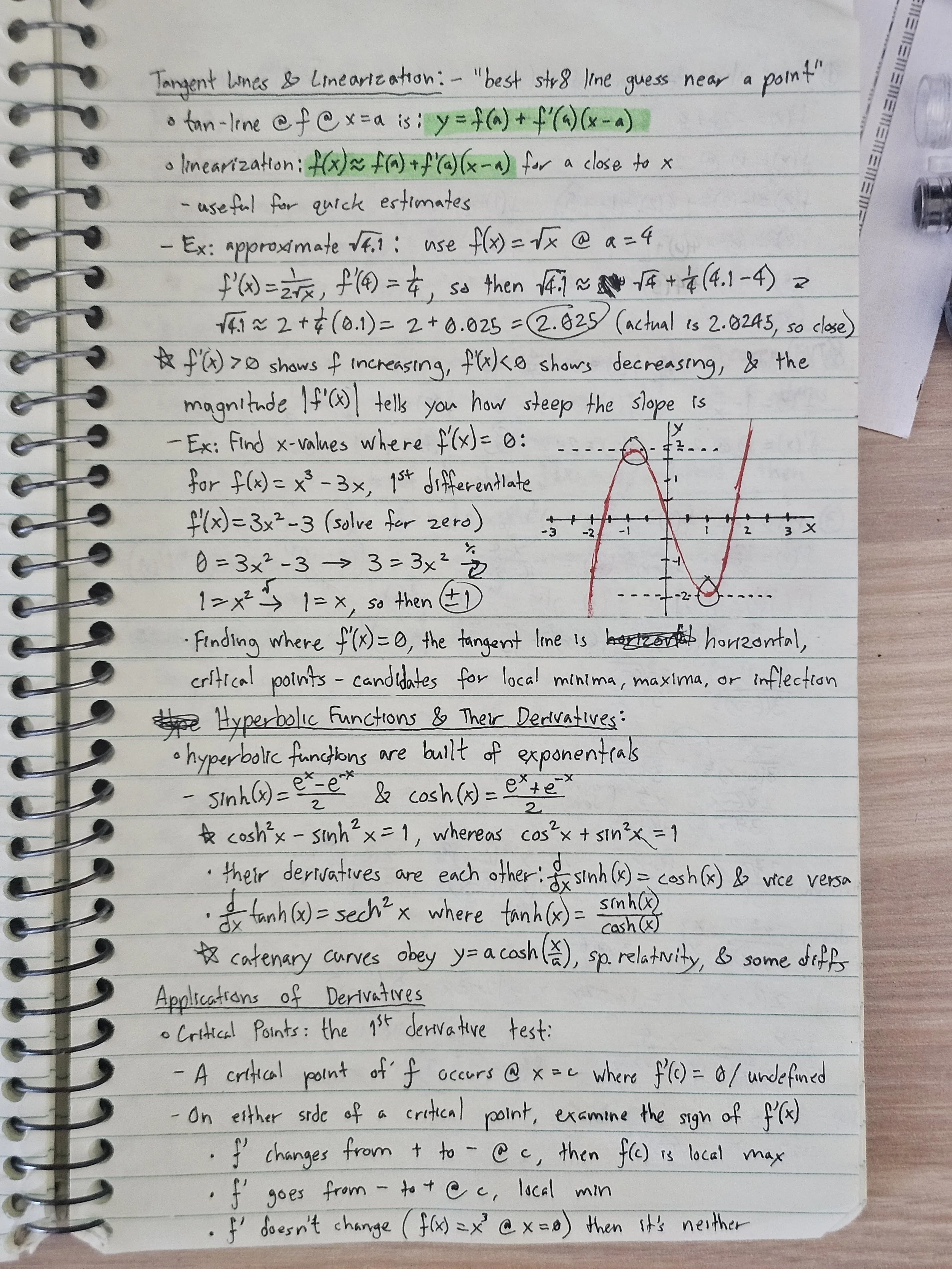
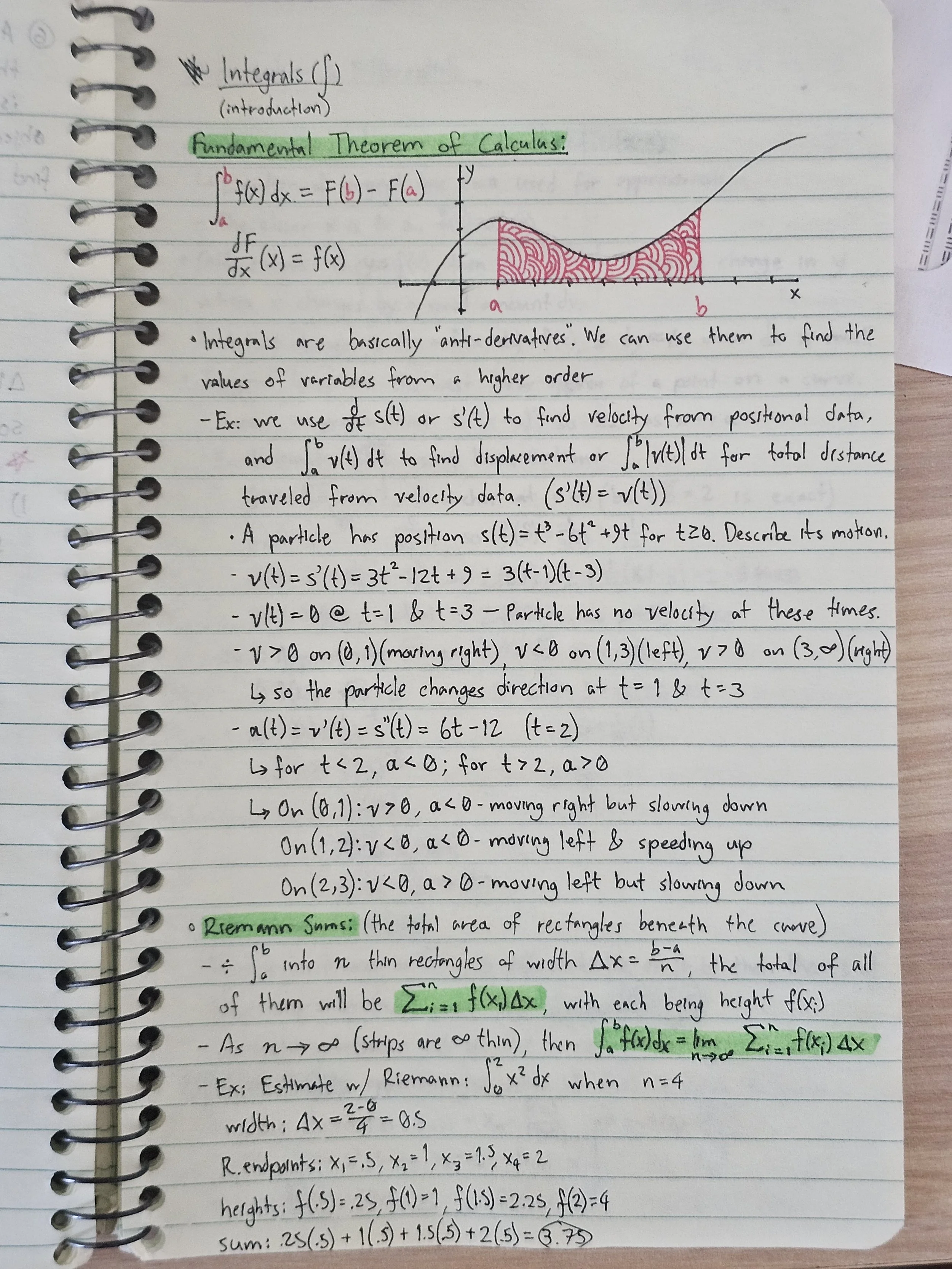
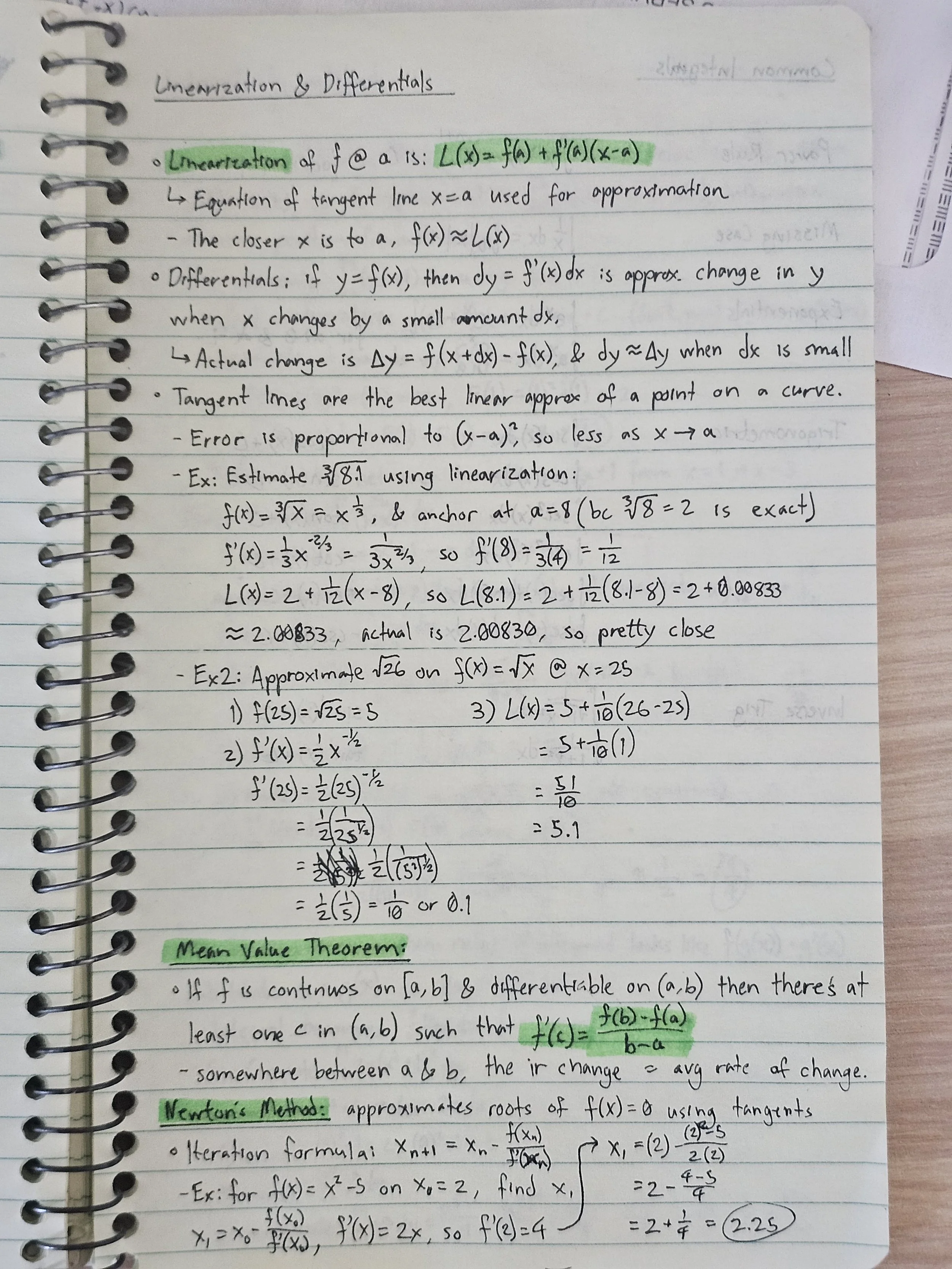
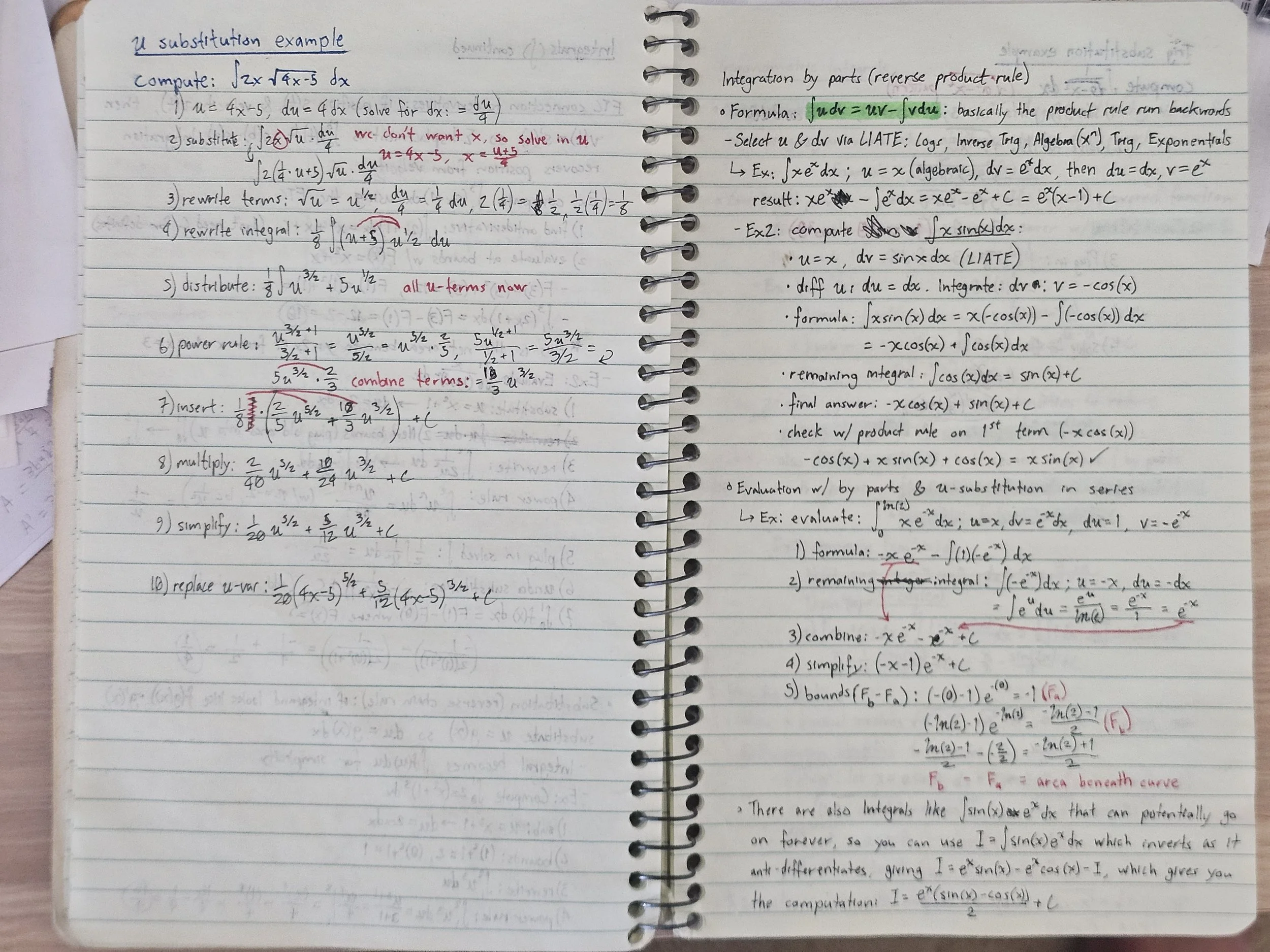
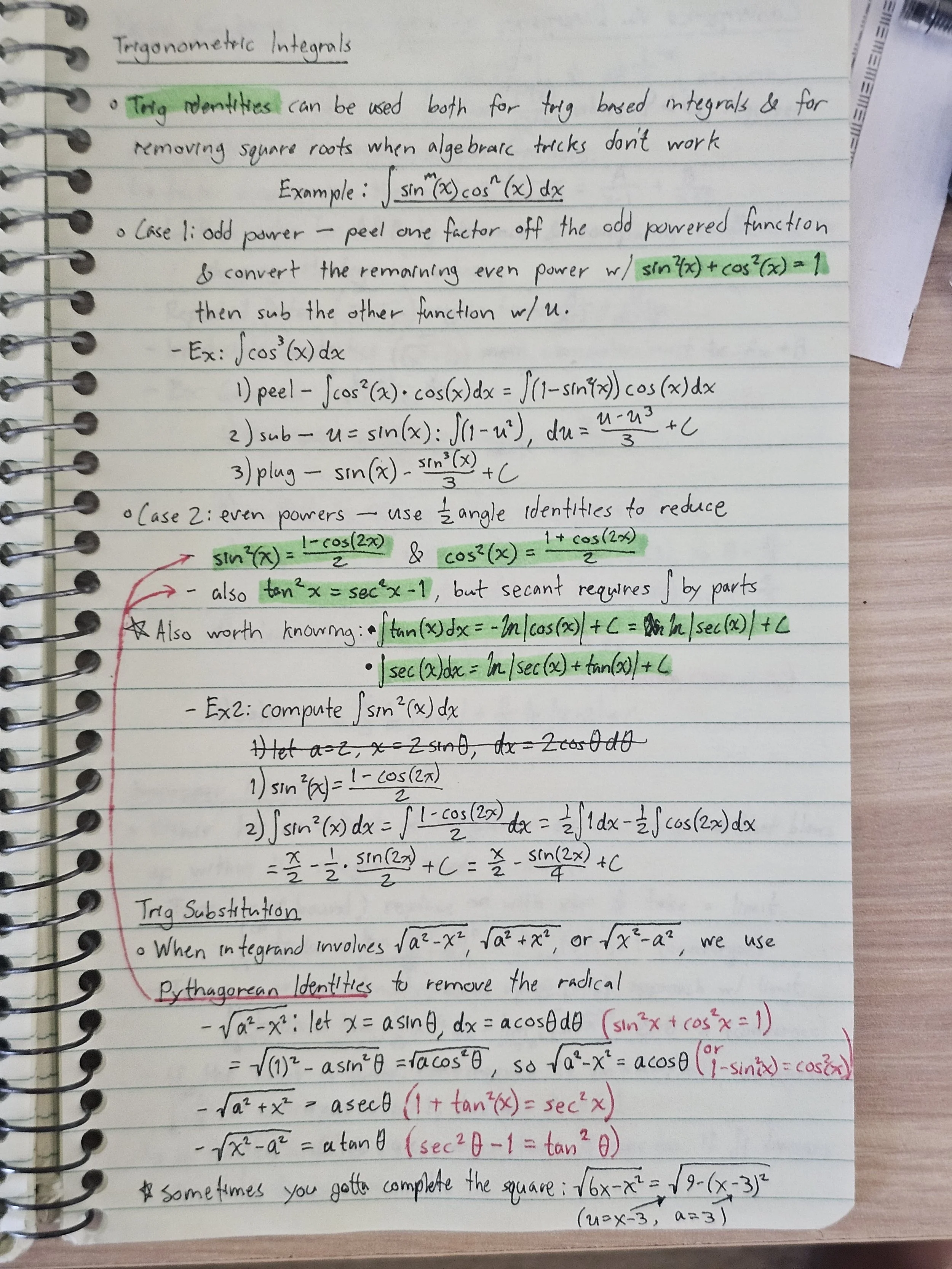
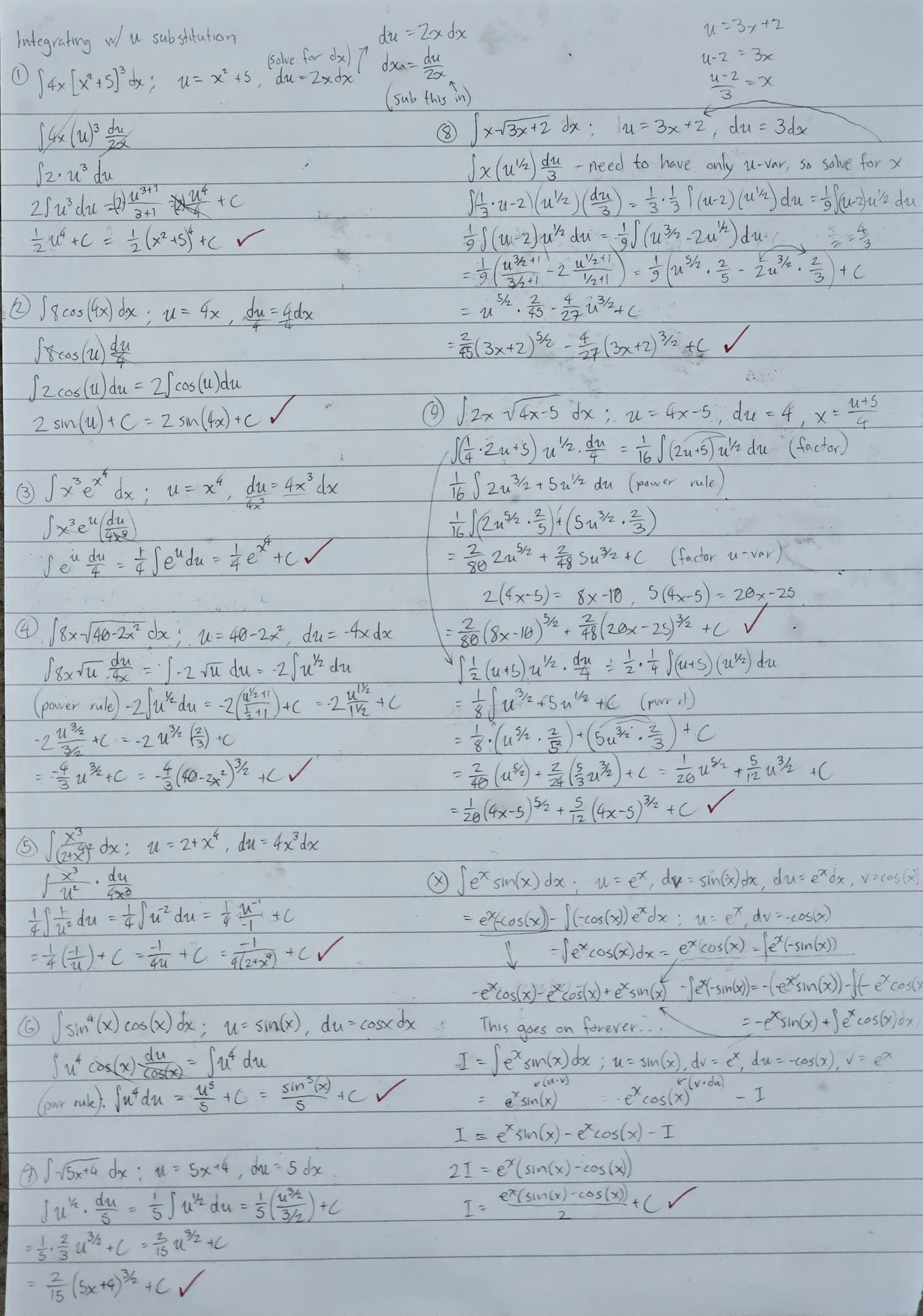
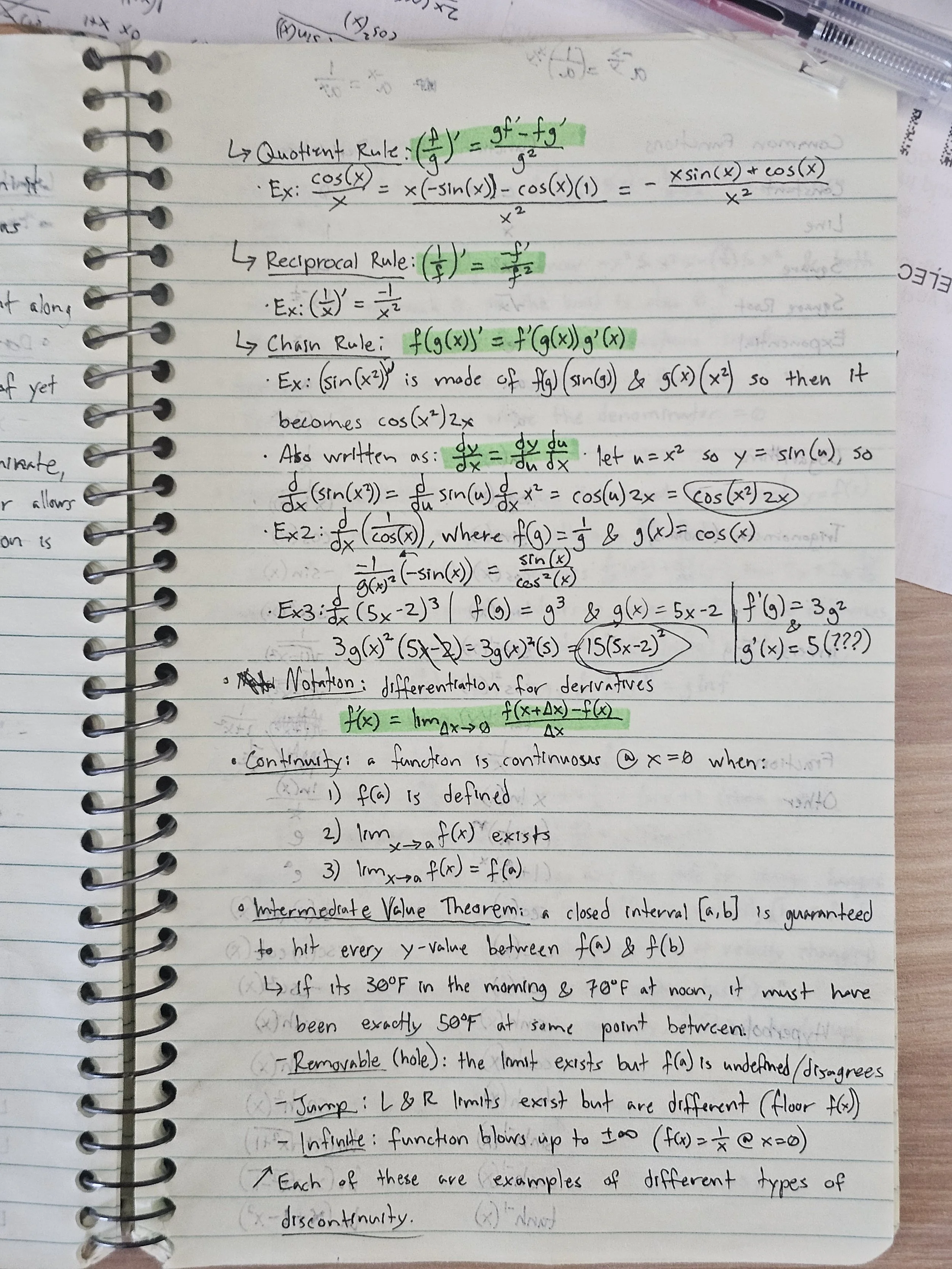
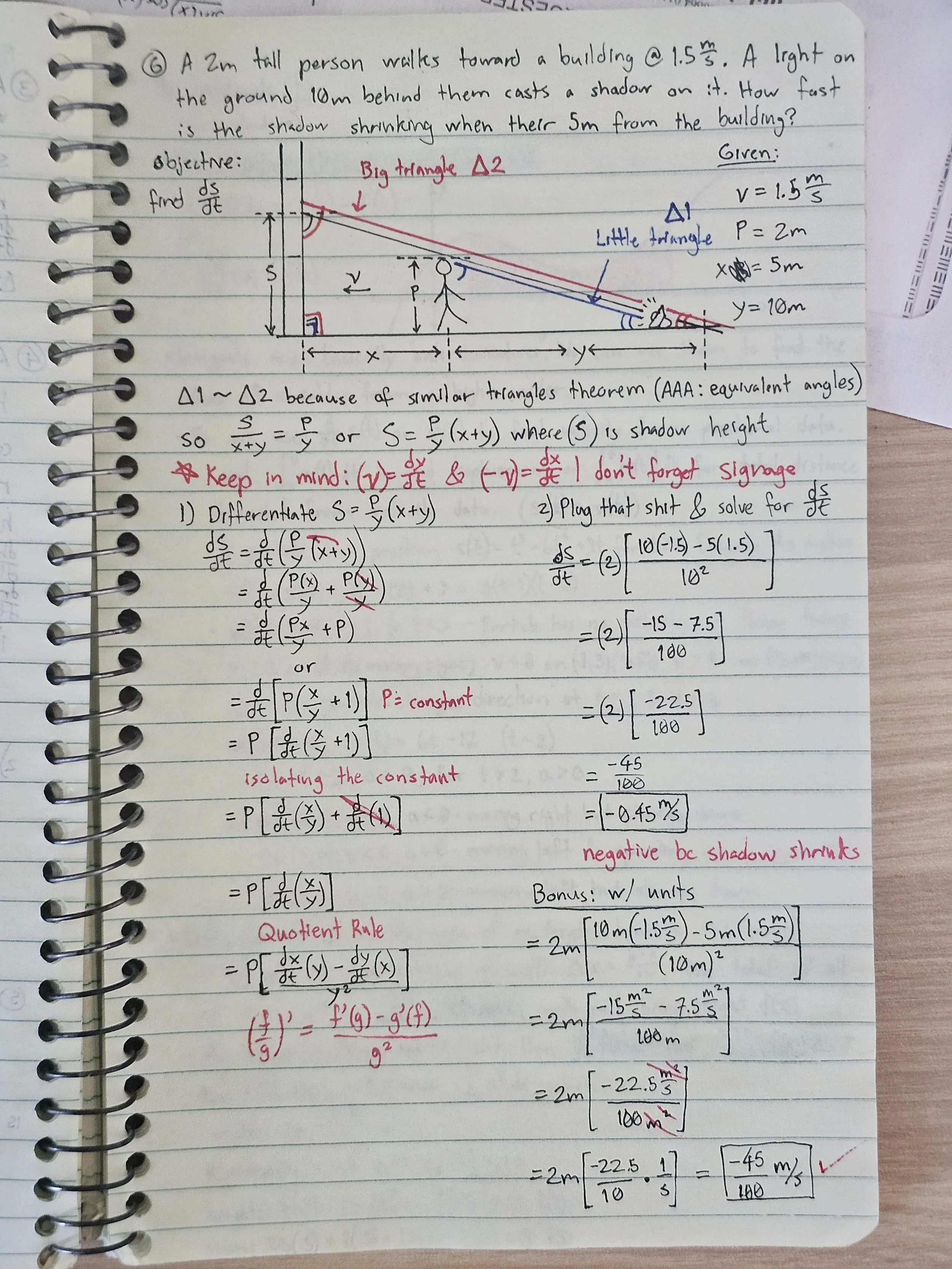
^An assortment of notes & practice questions
Anywhomst, as you can see, I leaned into Physics pretty hard for conceptualization, especially when I had to use Trig to find weird growth rates and stuff. And beyond Derivatives, Integrals, Limits, Continuity, Fractals, and , I couldn’t even see the horizon of crazy Calculus concepts left to learn. I was also told by several engineer friends to stay well away from multivariable calc, so I figured that was a good spot to end my learning journey. Well, almost. What’s the good of studying if you never take a test?
The Exam:
I’m gonna keep it real with you, I pretty much Frankenstein’d this exam together out of online AP Test questions, textbook questions, online evaluations, and whatever stuff I flagged as too difficult (at the time) during my studies. Would this text hold up to the scrutiny of an accredited institution? Who cares? I’m just some dude in his 30s learning high school/college math out of self-disgust, I absolutely do not need the approval of academia to complete this side-quest. The only vindication I require is my own; and so, here’s my custom Calc exam:
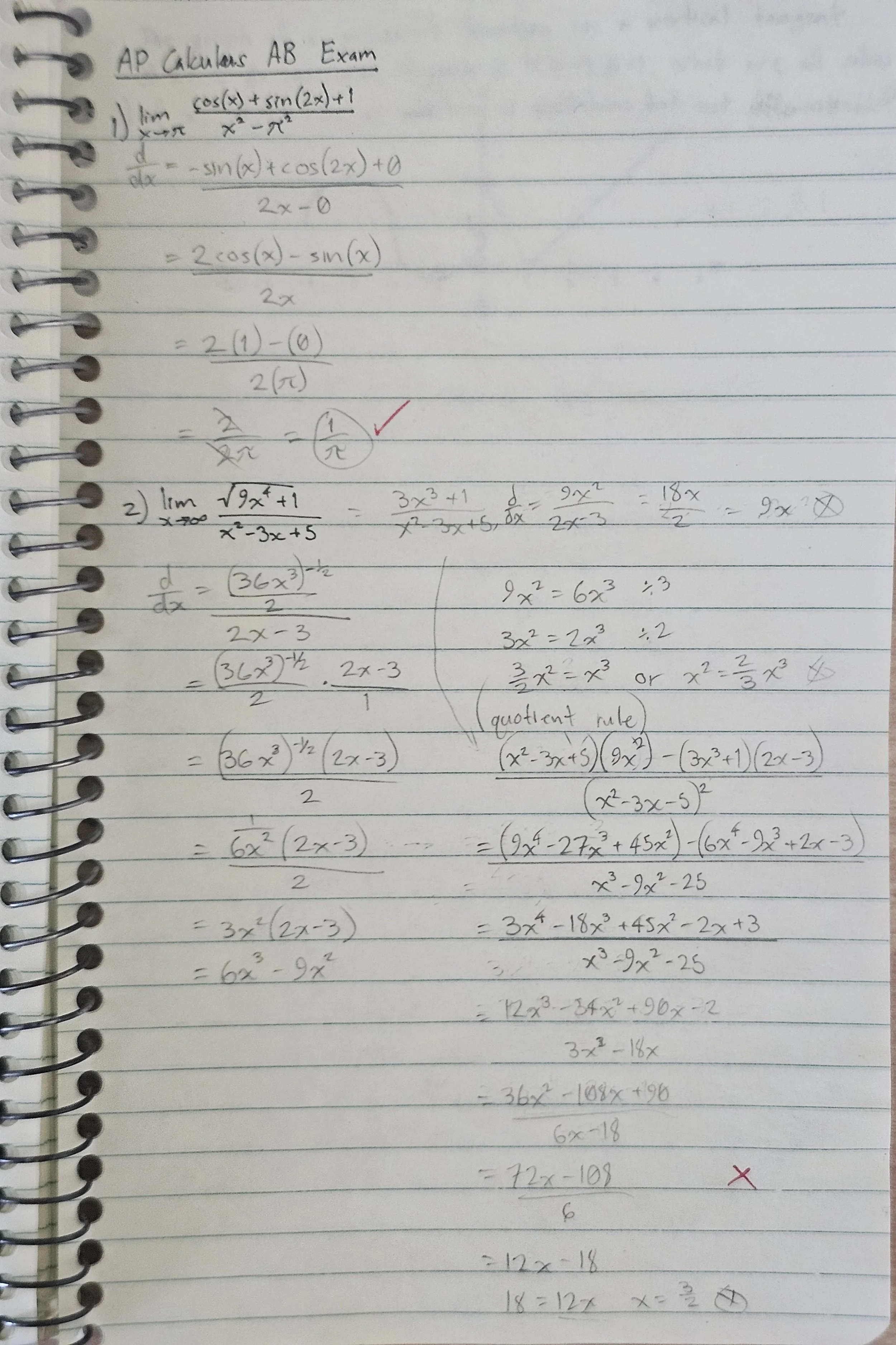
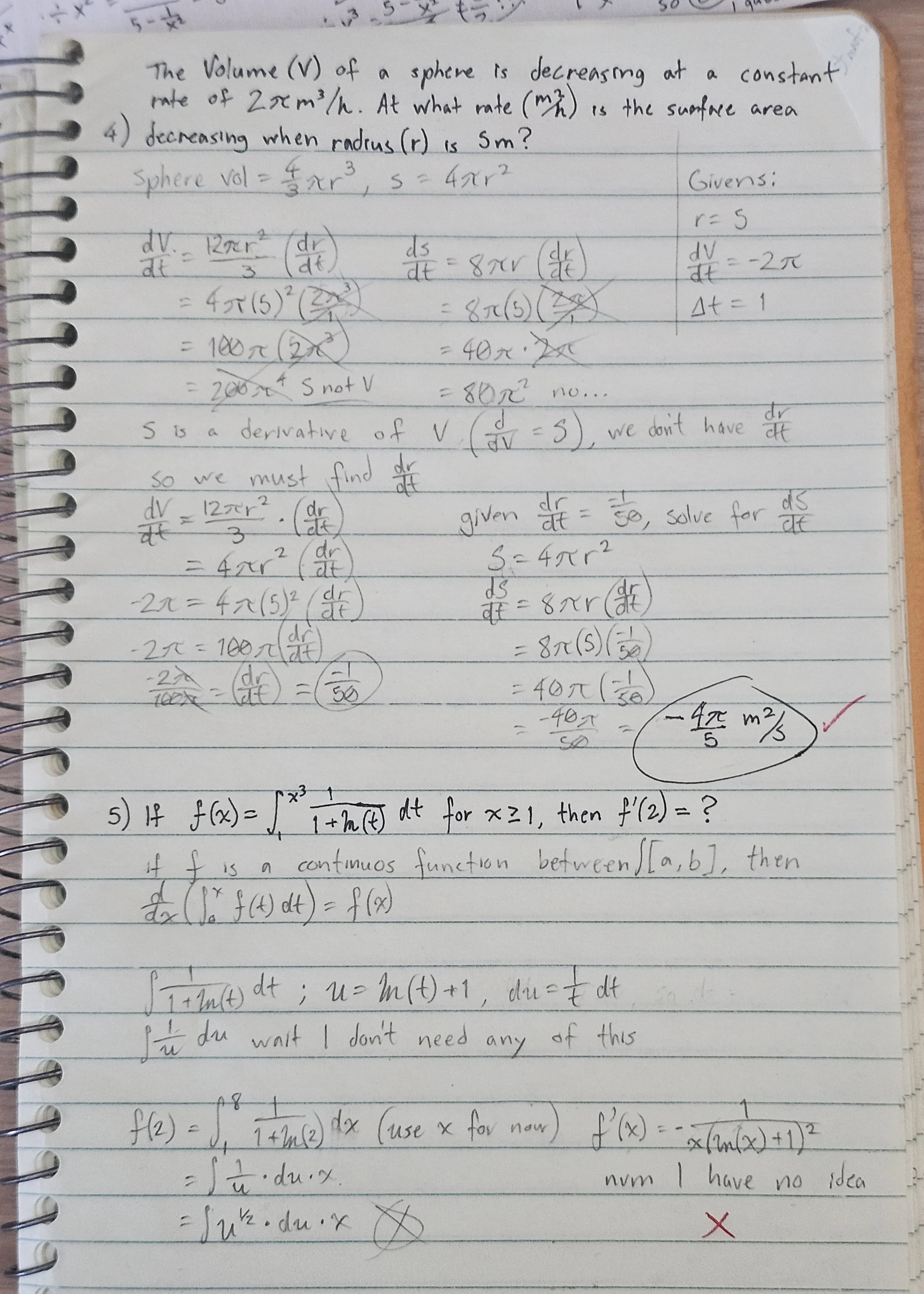
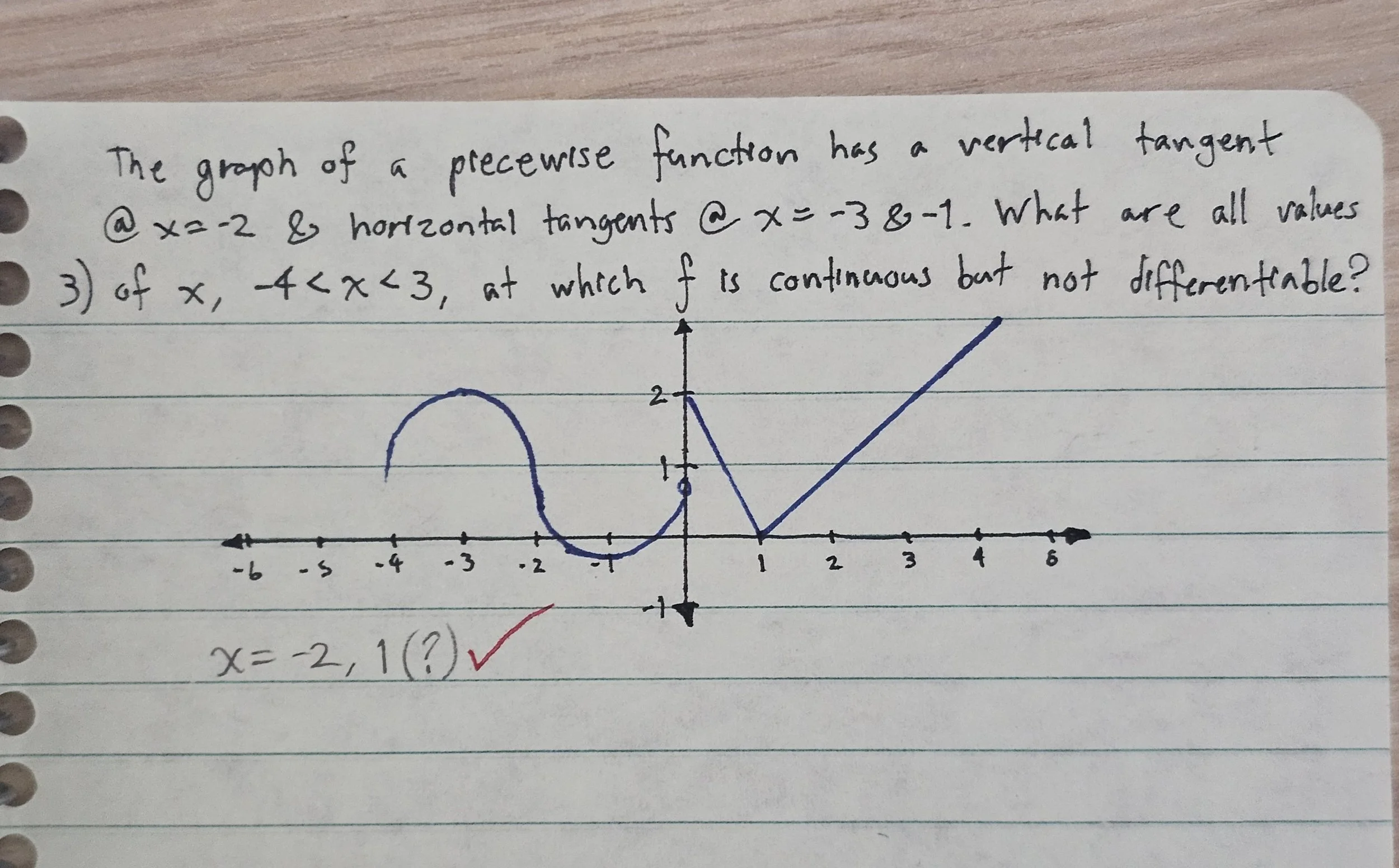
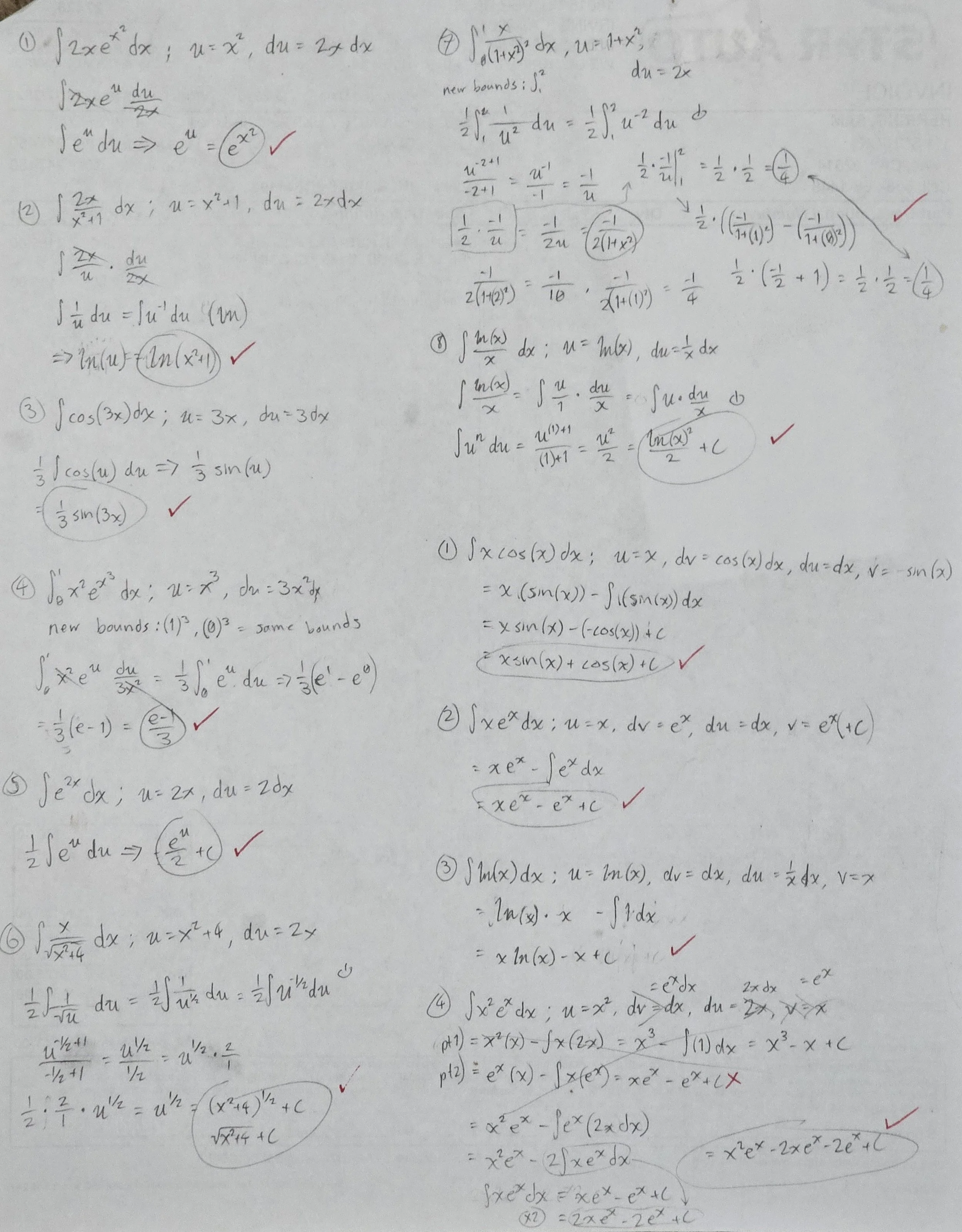
All in all, with the online exams, AP test questions, and textbook/online problem examples, my self-assessment included about 52 total questions. I don’t have them all pictured here (especially the online ones because I had to go back after and see which ‘incorrect’ answers were actually correct but not counted), but these should give you a decent idea of how I did.
AP questions: I got 7/10! Yeah that’s a C- but for a mathematical infidel like myself? BIG W
(see that 3rd pic about the piecewise graph? Know why I didn’t show any of my work? Bc I guessed it lol)Online exams (after double checking): I averaged about 80-85%. Lowkey feel like I would’ve done better if they were phrased better, because sometimes I looked for the wrong thing.
Textbook & online/forum questions: Only missed 3 out of 25! 88% success rate!
An overall 81% on however much Calculus I managed to cram into 1 month? I’m calling this side-quest not only complete, but also a resounding success. Throughout last month, I spent about 1-4 hours per day learning and practicing all this madness, and probably only missed around 4 days total (work/travel/etc.), which makes this one of the more involved goals I’ve given myself. I do feel like I’ve managed to bridge a lot of knowledge gaps and am able to understand several more basic engineering, bilogical, and physical principles, some of which I can even apply to my own life, but this one was [by nature] kind of a huge time & energy sink… but I’m proud as hell of myself for completing it.
For my next side-quest, I’m thinking “take more naps” or maybe even “make some friends”
